
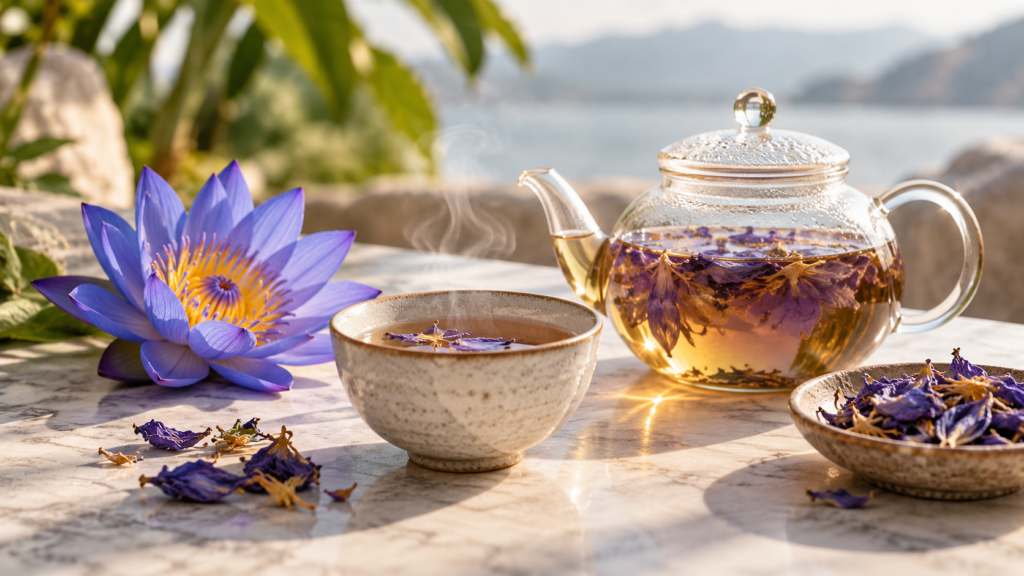
Blue lotus tea has a reputation older than almost any other herbal drink: a pale blue flower drawn on tomb walls, tucked into royal burials, and steeped, according to some historians, in ancient Egyptian wine. Today the flower is sold as loose petals, tea bags, tinctures, and extracts, usually with a rush of confident promises attached.
The trouble is that most of what you find online comes from shops. Product pages tend to tell you what blue lotus will do for you, while saying very little about what we actually know. This guide takes the opposite approach. It covers the flower’s real history, explains how people prepare it, and is upfront about how thin the modern research is.
What Is Blue Lotus?
Blue lotus is an aquatic flowering plant, Nymphaea caerulea, also known as the blue water lily, Egyptian lotus, or sacred blue lily. It grows in slow-moving fresh water, including the Nile and other parts of East Africa. Its star-shaped flowers have pale blue to lilac petals and a bright yellow center, and they open in the morning and close in the afternoon, a rhythm that fascinated ancient observers.
The look-alikes
When you shop for blue lotus tea, you may run into several similar-sounding names:
| Name on the label | What it usually is | Notes |
|---|---|---|
| Blue lotus, Egyptian blue lotus | Nymphaea caerulea | The plant historically linked to ancient Egypt |
| Blue star lotus | Nymphaea nouchali (also called N. stellata) | A related species native to South and Southeast Asia, sometimes sold as blue lotus |
| Sacred lotus, pink lotus | Nelumbo nucifera | A different plant with a different history, used in Asian cuisine and traditional medicine |
| White lotus | Nymphaea lotus | Another Nile-region water lily |
These plants can look alike when dried, and they are not chemically identical. A label that lists the botanical name is a small but meaningful sign that a seller knows what they are selling. A label that says only “lotus” tells you very little.
Where it grows today
Wild populations occur in parts of Africa, and the plant is also cultivated in other regions as an ornamental and for commercial harvest. Because supply chains for dried flowers are long and lightly regulated, the same product line can mix species without saying so. That is one reason quality and identity come up repeatedly in this guide.
Blue Lotus in Ancient Egypt
Few plants are as tightly bound to a civilization as the blue lotus is to ancient Egypt. Understanding that history is the best way to put modern blue lotus tea in context, because so much of what we say about the flower comes from images and objects, not written instructions.
A symbol of the sun and rebirth
The Egyptians noticed that the blue lotus closed and sank beneath the water at night, then rose and opened with the morning sun. That daily cycle made it a natural symbol of creation, the sun, and rebirth. In Egyptian myth, the sun god was sometimes said to have emerged from a lotus at the moment of creation.
The flower appears in temple carvings, wall paintings, jewelry, and the decoration of everyday objects, and it is associated with the god Nefertem, who is often shown with a lotus on his head.
In tombs and funerary art
The blue lotus appears repeatedly in funerary contexts. Depictions in tomb paintings show mourners and guests holding flowers, and garlands and petals have been found in burials. Tutankhamun’s tomb is often cited, with lotus motifs on objects and blue lotus flowers reportedly among the items placed with the young king. The flower’s association with rebirth made it a fitting companion for the afterlife journey.
The Use of Blue Lotus: Then and Now
When people ask about the use of blue lotus, the honest answer has two layers: what the plant has been used for historically, and what it is marketed for today. The two overlap, but they are not the same thing.
Traditional and historical uses
Beyond the ceremonial and artistic roles described above, blue lotus and related water lilies have appeared in several traditional contexts:
- Ritual and ceremony. The flower’s symbolism made it a common offering and adornment in religious settings.
- Perfume and oils. People used the fragrant flowers to scent oils, ointments, and garlands.
- Social settings. Banquet imagery suggests a role in festive gatherings.
- Traditional medicine. In some African and Asian folk traditions, preparations of water lily flowers and rhizomes have been used for a range of complaints. Records are sparse, uneven, and difficult to verify.
Notice how little of this amounts to a documented, specific use. Most of it is inferred from art and a scattering of ethnobotanical accounts.
Modern uses
Today, blue lotus is sold mainly to people drawn to its history or its reputation for relaxation. Common ways it is marketed include:
- As a calming evening tea. This is the most common and most conservative use, since a warm cup of herbal tea is a familiar ritual.
- As a tincture or extract, for people who want a concentrated preparation.
- As an aromatic, in incense, sachets, and perfumery, where the flower’s scent is the point.
- As an ingredient in blends, sometimes combined with other herbs such as chamomile, mint, or hibiscus.
- As a flavoring in some beverages and cocktails, where the flower is used mostly for its color and aroma.
What Is Actually Inside Blue Lotus?
To understand why blue lotus tea is both intriguing and difficult to evaluate, it helps to know what chemistry has been reported in the flower.
Apomorphine and nuciferine
Two compounds get most of the attention:
- Apomorphine: This is an alkaloid that is also a prescription drug in some countries, used in certain medical settings to treat symptoms of Parkinson’s disease. It acts on dopamine receptors. Laboratory analyses have reported its presence in blue lotus, though the amounts and consistency in dried flowers and consumer products remain unclear.
- Nuciferine: An aporphine alkaloid also found in the sacred lotus. Laboratory studies suggest it interacts with several receptor systems, including dopamine and serotonin receptors. Most of what is known comes from animal and cell studies, not human trials.
Blue lotus also contains flavonoids and other plant compounds, including antioxidants, which are common in many flowers and herbs and are not unique to this one.
Why the chemistry is hard to pin down
Three issues make it difficult to say what a given cup of blue lotus tea contains:
- Variability. Plant chemistry changes with species, growing conditions, harvest time, and drying and storage methods. Two batches can differ substantially.
- Preparation. Compounds dissolve differently in water, alcohol, and wine. A hot water infusion is not chemically the same as an alcohol tincture.
- Mislabeling. Because related water lilies are sometimes sold as blue lotus, the flowers in a bag may not be Nymphaea caerulea at all.
The practical takeaway is that nobody, including the seller, can promise a specific dose of any active compound in a cup of blue lotus tea unless the product has been tested and the results are shared. Compounds with drug-like activity call for that kind of transparency.
The Research Base: Thin, and Worth Saying So
This is the section that most shop pages skip. To understand blue lotus tea, you need to know how little formal evidence exists.
What research does exist
A small body of laboratory and animal research has examined blue lotus extracts and their compounds. Some of it suggests activity related to antioxidant effects, to the nervous system, and to inflammation. Studies on nuciferine, mostly in animals and cells, have explored possible effects on receptor systems. These findings are scientifically interesting.
What research does not exist
There are almost no well-designed clinical trials of blue lotus in people. That means we lack good answers to basic questions:
- Does blue lotus tea actually improve sleep, mood, or anxiety in humans?
- What amount, if any, is safe and effective?
- How does it interact with medications, alcohol, or other herbs?
- What are the effects of long-term use?
- Is it safe in pregnancy, in children, or in people with health conditions?
None of these have solid, published answers. Animal and cell studies cannot substitute for human trials, because results often fail to carry over from a lab dish or a rodent to a person.
How to Use Blue Lotus: The Forms You Will Find
If you are wondering how to use blue lotus, the first step is knowing which forms exist, because each behaves differently and carries different considerations.
| Form | What it is | What to know |
|---|---|---|
| Dried whole flowers or petals | Whole or broken flowers, dried | The most traditional form for tea; lets you see and smell what you are buying |
| Tea bags | Petals, often cut and blended | Convenient, but quality varies, and blends may contain little actual blue lotus |
| Powder | Ground dried flower | Harder to verify identity; can be used in infusions |
| Tincture or extract | Flowers steeped in alcohol or another solvent | Concentrated, and chemistry differs from a water infusion; alcohol content matters |
| Resin or concentrate | Concentrated extract | Potency is often unclear and rarely verified |
| Smokable or vaping material | Dried flowers or extracts sold for inhalation | Little to no safety data; inhalation adds its own risks |
| Aromatics and sachets | Flowers used for scent | Used for fragrance, not ingestion |
How to Take Blue Lotus: Preparing Blue Lotus Tea
There is no established, evidence-based dose, so the guidance below describes a common, modest way to prepare a cup, not a recommendation about how much anyone should drink.
What you will need
- Dried blue lotus flowers or petals (check that the botanical name is on the label)
- Fresh, hot water, just off the boil
- A mug or teapot with a lid or saucer to cover it
- A fine strainer or infuser
- Optional: honey, lemon, or a milder herb to blend
Step-by-step preparation
- Measure lightly. A common starting point is about one teaspoon of dried petals per cup, roughly 1 to 2 grams. Begin at the low end, especially if you have never tried the flower.
- Heat the water. Bring water to a boil, then let it rest for a minute or so. Slightly cooler water, around 90 to 95 degrees Celsius (195 to 205 degrees Fahrenheit), treats delicate flowers more gently than boiling water.
- Steep. Pour the water over the petals and cover the cup to hold in aroma. Steep for about 5 to 10 minutes. Shorter steeping gives a lighter cup, and longer steeping gives a deeper flavor and color.
- Watch the color. A well-made infusion often turns a pale gold to soft blue-green, depending on the flowers.
- Strain and sip. Remove the petals and drink warm, slowly, noticing how you feel.
- Wait before repeating. Because there is little research on how blue lotus affects people, do not stack cups back to back. Give yourself time to notice any response.
Practical tips for a first cup
- Try it when you have nothing demanding to do. Avoid driving or operating machinery, since the effects on alertness are not well characterized.
- Do not combine it with alcohol, sedatives, or other new supplements on the same day.
- Start once, at a small amount, and notice how you respond before deciding whether to try it again.
- Store dried flowers in an airtight container away from light, heat, and moisture to preserve aroma and reduce the risk of mold.
Precautions, Legal Status, and Buying Quality Flowers
Because the research is thin, precaution matters more than usual with blue lotus tea. Here is what to think through before you start.
Who should be especially careful
- Pregnant or breastfeeding people. Reliable safety data is lacking, so avoiding it is the prudent choice.
- Children and teenagers. Not studied, and not appropriate without medical guidance.
- People taking medication. Because blue lotus contains compounds with drug-like activity, including apomorphine and nuciferine, interactions are possible, particularly with medications that affect dopamine or serotonin, sedatives, blood pressure medications, and drugs for Parkinson’s disease or mental health conditions. Ask a pharmacist or prescriber.
- People with health conditions, especially heart conditions, low blood pressure, liver problems, or psychiatric conditions.
- Anyone scheduled for surgery, since effects on anesthesia are unknown.
- Anyone with a history of substance use problems, who may want to talk to a professional about botanicals with mind-altering reputations.
Possible side effects and warning signs
Because there are few human studies, reliable side effect data does not exist. Consumers describe effects such as drowsiness, dizziness, nausea, and changes in mood or perception, but those are anecdotal. Stop and seek medical care if you experience severe drowsiness, fainting, a racing or irregular heartbeat, confusion, difficulty breathing, or any allergic reaction such as hives or swelling.
Interactions to avoid
- Alcohol. Adds to drowsiness and impairment.
- Sedatives and sleep aids. May compound sedation.
- Other mind-altering substances. Combined effects are unpredictable.
- Other new supplements. Introduce only one new botanical at a time, so you can tell what is causing any effect.
Legal status
The legal picture for blue lotus varies by country and, within some countries, by state or region. In the United States, blue lotus is not a federally scheduled controlled substance, but the FDA has not approved it as a drug, and some jurisdictions regulate or restrict it. Other countries treat it differently, and rules change. Before buying or traveling with blue lotus products, check the current law where you live and where you are going.
How to buy a quality product
Quality is one of the biggest problems in the blue lotus market. Look for these markers:
- The botanical name. The label should say Nymphaea caerulea, not just “blue lotus” or “lotus.”
- Whole or visibly identifiable flowers. You should be able to see what you are buying. Fine powders and heavily processed blends make substitution easier.
- A clear ingredient list. Blends should state the percentage of blue lotus.
- Batch-specific lab results. Look for a certificate of analysis that matches your batch number and covers identity, heavy metals, microbial contamination, and pesticides. A trustworthy seller should be willing to share it.
- Honest claims. Be wary of products promising to treat sleep problems, anxiety, or any medical condition, or claiming a guaranteed effect.
- Origin and harvest information. Sellers who know where and how they grew and dried their flowers tend to be more careful overall.
- Fresh aroma and appearance. Dried flowers should smell pleasantly floral and look free of mold, dampness, or dark discoloration.
Frequently Asked Questions
What is blue lotus tea?
Blue lotus tea is an infusion made by steeping dried Nymphaea caerulea flowers, a water lily associated with ancient Egypt, in hot water. It is usually described as mild and floral.
Did the ancient Egyptians really drink blue lotus tea?
We do not know for certain. Blue lotus appears constantly in Egyptian art, including banquet scenes, and some scholars think the flowers were infused in wine or water. But there is no clear written recipe, and interpretations of the imagery are debated.
Is blue lotus the same as the lotus flower used in Asian cooking?
No. The sacred lotus (Nelumbo nucifera) is a different plant in a different family. Blue lotus is a water lily.
How do I know what dose is right?
There is no established, evidence-based dose. Any amount described in this article is a modest tea preparation, not a recommendation. If you have health conditions or take medication, ask a healthcare provider before trying it.
Is blue lotus safe?
The honest answer is that we do not have enough human research to say. It contains compounds with drug-like activity, so caution is warranted, especially in pregnancy, with medications, and alongside alcohol or sedatives.
Is blue lotus legal?
In the United States it is not federally scheduled, but rules vary by state and country and can change. Check the law where you live.
Can blue lotus tea replace medication or treat a condition?
No. No evidence shows it treats any condition, and it should never replace prescribed care.
Final Thoughts
Blue lotus tea sits at an interesting intersection of history, botany, and marketing. The flower is genuinely remarkable, central to Egyptian art and symbolism for thousands of years, and steeping it in a cup is appealing. But the same enthusiasm that makes the plant popular has also produced a market full of confident claims that the research does not support.
If you decide to try it, the sensible path is a simple, clearly labeled dried flower, a modest cup of tea, a low-stakes moment, and an honest awareness of how little we know. Choose sellers who name the species and share lab results. Talk with a healthcare provider if you take medication or have a health condition. And keep in mind that a plant can be historically fascinating without being proven.
More Resources
Comprehensive guide to kratom concentrates
Kratom Extract vs Powder: Deep Dive Comparison